

Draughts: different rules of the game in particular countries
Even such a classic board game as draughts can evoke high emotions and make you acting under increasing pressure. Especially if it turns out that your opponent follows completely different rules of the game and insists on the kings' short movements. On the other hand, you still remember from your childhood the "huffing rule" - while playing draughts you need to be careful and not to omit any capture, otherwise you lose your piece. Check if the rules you follow are correct and what variant of the game you actually play in. Learn the rules specific to particular countries.
Classic draughts, also known as Brazilian draughts
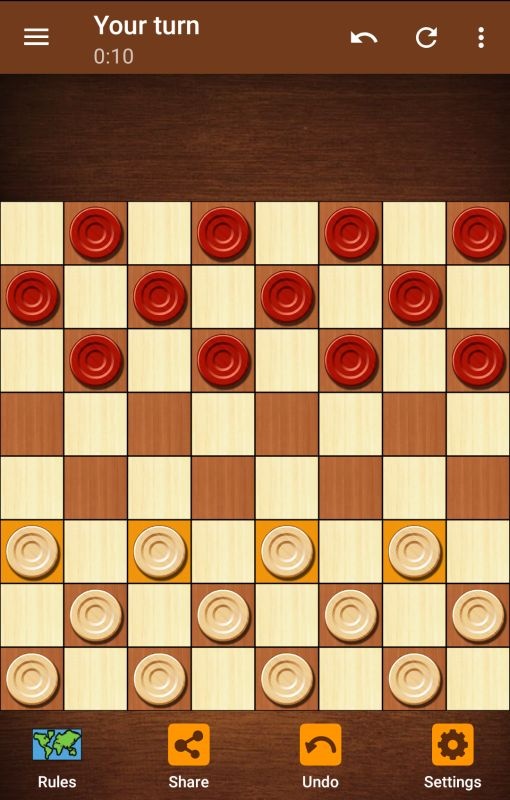
Board
Players use the 8x8 board and place their pieces on the dark squares. The board is set in such a way that the first field on the left side of each player is a dark field. In this variant, the board is often green and players use white and red pieces.
Pieces
Each player at the beginning of the game has 12 pieces. The white piece starts a game. Pieces can move one space forward, diagonally.
Capturing
You can capture forwards as well as backwards. Capturing is
mandatory. The player should also choose the most numerous
capture sequence i.e. the one thanks to which he would
capture as many opponent's pieces as possible. However, the
king's capturing doesn't need to be a priority in this
case.
If the player does not notice that he should
capture the other player's piece(s), then he is obliged to
move back to make a capturing move.
King
King can move diagonally any number of fields, forwards or backwards - these are called "flying kings". King can stop on any square behind the piece that was captured. A piece becomes a king if it reaches the promotion line of the board (the most distant row on the opponent's side) and stops on it.
International draughts, named also Polish draughts
Championships in draughts and many other tournaments are played following these rules.
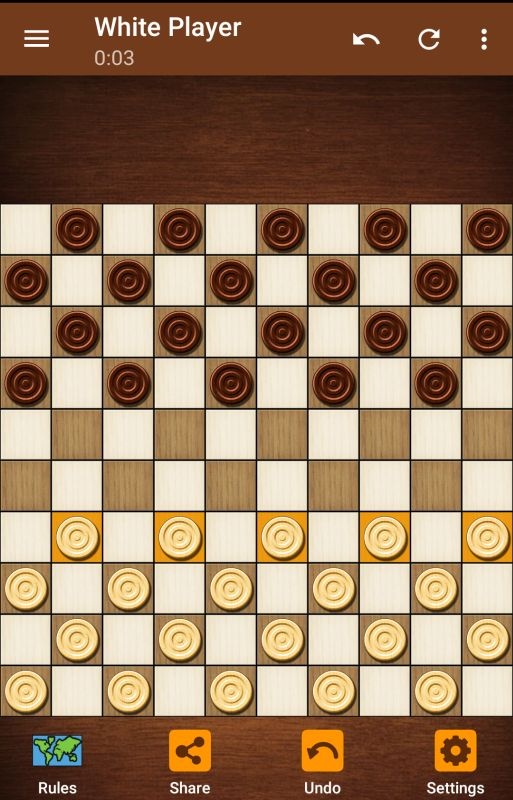
Board
10x10, the game is played on the dark fields. Board setting - the first field on the left side of each player is a dark one.
Pieces
Each player uses 20 pieces (in four rows). The white piece is the first to start a game.
The other rules are as in classic draughts (Brazilian variant) i.e.:
Capture
You can capture forwards and backwards. Capturing is
obligatory. The player should also choose the most numerous
sequence of capturing (to capture as many opponent's pieces
as possible) - it does not matter if the opponent's piece is
a queen/king.
If the player fails to capture, he should
move back and undo the error.
King
"Flying kings" - they can move any number of fields
diagonally.
A piece becomes a king if it reaches the
promotion line and stops on it.
Russian draughts (shashki)
The game variant that is popular in Russia, Kazakhstan, Kyrgyzstan, Armenia, Azerbaijan and other countries of the former USSR. Also known in Israel.
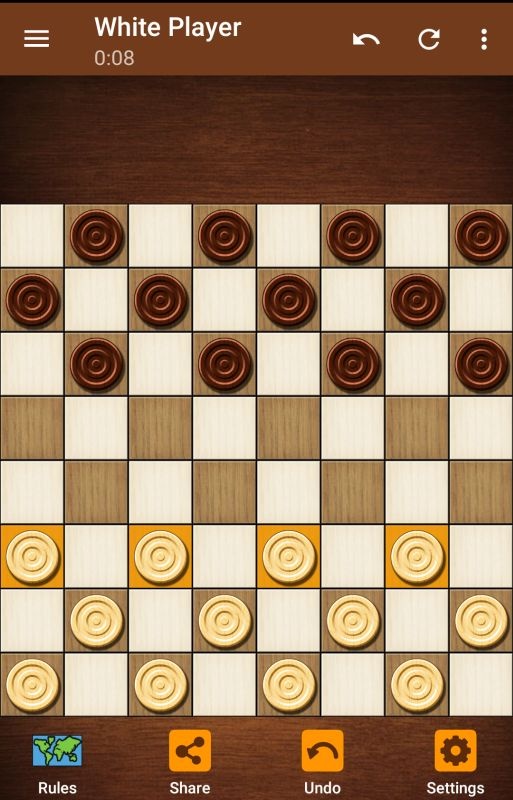
Board
8x8 board, the game is played on the dark fields. The first field on the left side of each player is a dark one.
Pieces
12 pieces on the board, they move diagonally one space forwards.
Capturing
Capturing forwards and backwards is mandatory. However, the player is not obliged to capture as many pieces as possible, he can choose any capture. If the player does not notice that he should capture the other player's piece(s), then he is obliged to move back and to capture them.
King
Every piece that reaches the promotion line on the
opponent's side changes into a king - however, it does not
have to stop on this line. The characteristic of the Russian
draughts is that the piece which while capturing crosses the
promotion line, becomes a king (and it ends capturing as a
king). The piece doesn't need to stop at the promotion line
to become a king.
[screen?]
English draughts, also known as American checkers or straight checkers
The game variant popular in Anglo-Saxon countries - in the United Kingdom, the United States, Ireland, Australia, New Zealand and Canada.
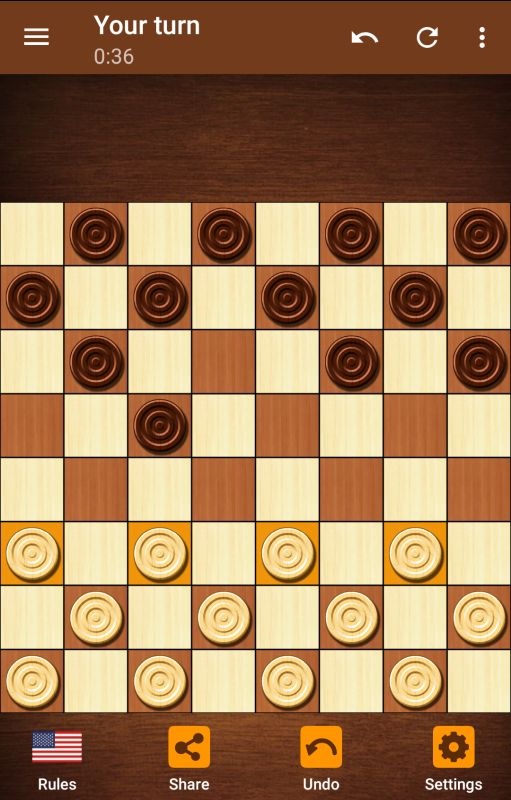
Board
8x8 board, the game is played on the dark fields. The first field on the left side of each player is a dark one.
Pieces
Each player has 12 pieces. The player using the dark pieces makes the first move. Pieces move diagonally, one square forwards.
Capturing
Capturing is obligatory, but regular pieces can only capture forwards. The player is not obliged to capture the maximum possible number of pieces, he can freely choose a sequence.
If the player fails to capture, he should move back and undo the error.
King
No "flying kings". Kings can make only short movements, it means one field forwards or backwards. A king can capture backwards. A piece becomes a king if it reaches the promotion line and stops on it.
Italian draughts
Board
8x8, set in such a way that the field in the bottom left corner is white - differently to classic checkers.
Pieces
Each player has 12 pieces
Capturing
Capturing is mandatory, but the regular pieces can only capture forwards. The player has to decide on the most numerous sequence of capturing - remember about the king's priority which means that capturing of the king is always more important that capturing of the regular piece. Last but not least, one king can be captured only by another king.
King
No "flying kings" - similarly to American checkers a king can only move one square and capture forwards as well as backwards. A unique feature of the Italian variant of draughts is that a regular piece is not able to capture a king.
Spanish draughts
Board
8x8 - the same as in the case of classic draughts, yet the game is played on the white squares.
Pieces
12 pieces on the game board
Capturing
Capturing is obligatory but pieces are only able to capture forwards. The player ought to choose the most numerous sequence of capturing.
King
"Flying kings" - it can move diagonally any number of fields.
Turkish draughts
Especially popular in Turkey and other Middle East countries (including Egypt and Lebanon).
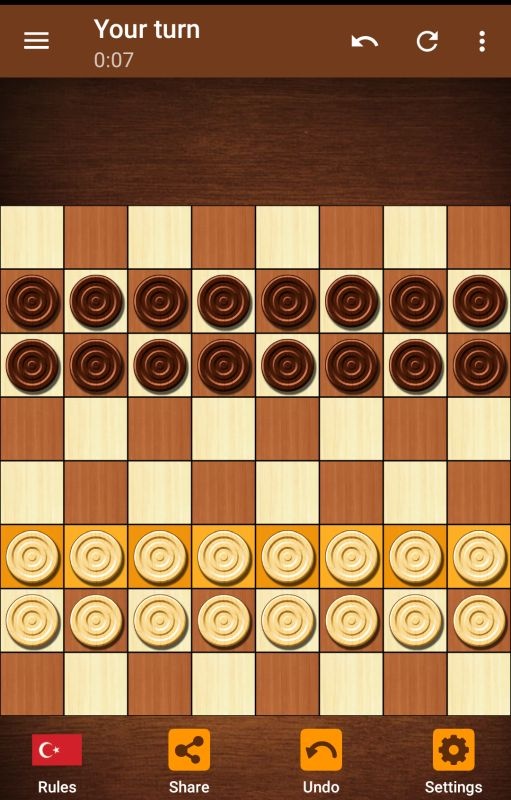
Board
8x8, pieces are placed next to each other on all squares, both black and white.
Pieces
Each player has 16 pieces. The pieces are set in two rows -
in such a way that one row at the very bottom and the one at
the top of the board are empty.
Pieces can move only
straight - forwards or sideways. Diagonal or backward
movements are not allowed.
Capturing
Capturing is mandatory. The piece jumps over the opponent's
pieces in a straight line. Multiple capturing is allowed -
in such a sequence a piece can change the direction of its
movement, e.g. the piece can capture forwards and then
sideways.
The player should choose the most numerous
capturing i.e. to get a maximum number of the opponent's
pieces.
The variant of Turkish draughts is
exceptional as just after capturing the piece is immediately
removed from the game board. This characteristic allows
jumping again over the same field during one movement.
King
A pawn becomes a king on condition that it reaches the promotion line on the opponent's side - a pawn does not have to stop on that line (similarly to the Russian draughts). A king can move any number of squares, horizontally or vertically (following the same rules as the rook in chess).
Thai draughts (Thai checkers)
The variant of draughts or checkers played in Thailand.
Board
8x8, set in the same way as the game board in classic draughts
Pieces
Each player has only 8 pieces (so they are placed in two rows). Pieces can move diagonally forwards.
Capturing
Pieces can only capture forwards. Capturing can not be skipped or postponed ("huffing rule") - if any player does not make a capture in his turn, then his opponent is allowed to take his pawn/piece. Consequently, the player who didn't notice his own capturing may lose his piece.
King
"Flying kings" - there is one exception, however, i.e. capturing a king has to stop on the field directly behind the captured piece .
Ghanaian draughts (also Ghanaian checkers)
Board
10x10, the game is played on the dark squares and set in such a way that the first field on the left side of each player is a white square.
Pieces
Each player has 20 pieces. The first move belongs to the whites.
Capturing
You can capture forwards and backwards. Capturing is
compulsory, but the player can choose any of the possible
sequences.
The player who stays with only one
pawn/piece cannot continue the game - he is a loser.
King
"Flying kings", also a king is allowed to stop on any square behind the captured piece. The pawn becomes a king if it reaches the promotion line on the opponent's side and stops on it.
return
Do you want to check your skills?
Play draught Entirely for free
